Most beaches have the sea in front and the road behind. Koukounaries on Skiathos has a forest behind it. Stone pines come almost down to the sand, and further in, behind the trees, lies a lagoon with reeds and birds.
The forest
The stone pine (koukounaria in Greek) is the pine that gives pine nuts, the seeds used in sweets and cooking. On Skiathos it forms one of the best-known forests of its kind in Greece, and that is where the beach gets its name. The trees are broad, with umbrella-shaped crowns, and at summer noon they give deep shade.
The lagoon
Behind the forest lies the lagoon of Strofylia, a wetland connected to the sea. It is a refuge for birds and small fish, and together with the forest it is a protected area. Few of those who come for a swim walk the few steps to it, which is a pity: in the morning, before the crowds arrive, it is one of the quietest spots on the island.
The beach
The sand is fine and pale, and the water stays shallow for quite a few metres, which makes it a favourite with families. In July and August it fills up. In September and early October it changes character: the sea is still warm, there are fewer people and the light is lower.
Skiathos beyond the beach
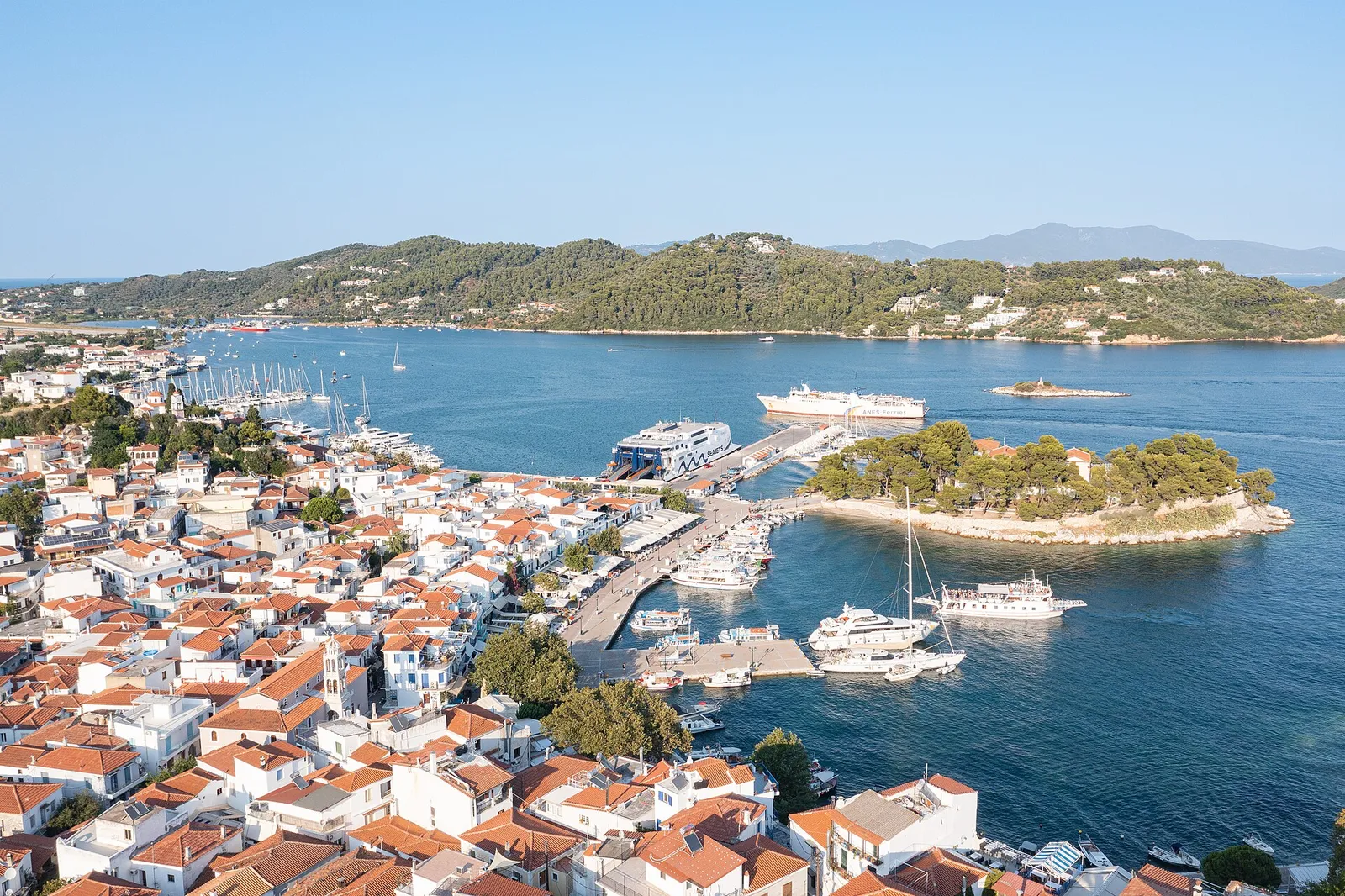
Skiathos has dozens of beaches, but also an interior few people know. Forests, footpaths, the monastery of Evangelistria, and the old Kastro at the northern tip, where the islanders hid from pirates. And of course Papadiamantis, who was born and died here and wrote his stories with Skiathos at their centre.
Practical notes
Koukounaries is on the south-west side of the island. A bus runs from Skiathos town, stopping at all the beaches along the way, and Koukounaries is usually one of the last stops. If you have a car, you will find a parking space more easily in the morning.
Respect the forest: don't light fires and don't leave rubbish. It is one of the most sensitive places on the island.