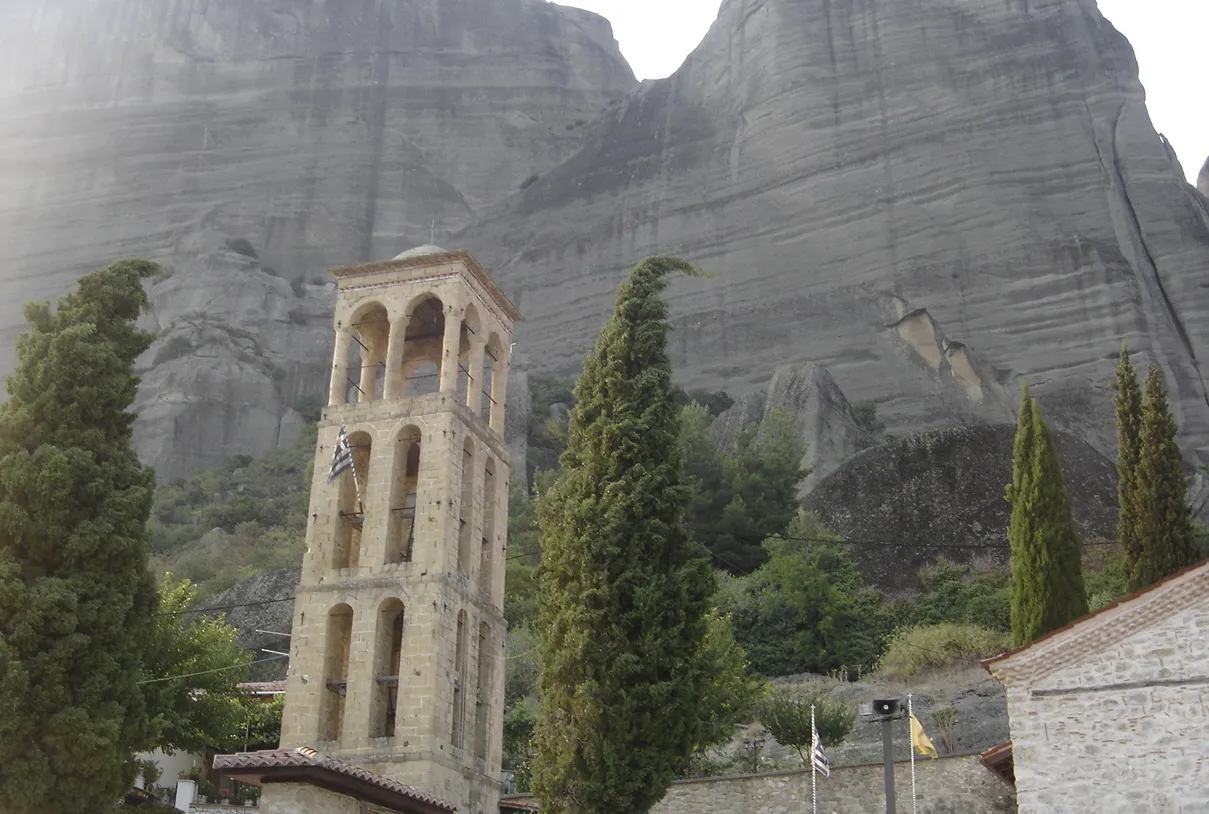
Most visitors to Kalambaka look up, towards Meteora. Few lower their eyes to a church that stood in the town long before most of the monasteries on the rocks: the church of the Dormition of the Virgin.
An old church
The church is Byzantine, one of the oldest in the area. It has the form of a basilica, with aisles and colonnades, a shape that recalls the first Christian churches. In its present form it shows phases from several periods, since, like every old building, it was repaired and remodelled many times. On the exact dating of those phases, specialists hold different views.
In Byzantine times Kalambaka, then Stagoi, was the seat of a bishop, and this was its main church.
The wall paintings
The interior is covered in wall paintings, many from the post-Byzantine period, recalling the art of the Meteora monasteries. The marble pulpit in the centre of the church stands out, a feature that rarely survives in Greek churches.
The atmosphere is quiet and moving, with light coming in through small windows. It is a place to stand and look at your own pace, without the crowds of the big monasteries.
How to find it
The church is in the upper part of Kalambaka, in the old town, below the rocks. Walk up from the centre: you will climb through narrow lanes with old houses. Visits are at set hours and usually with a small ticket. Dress modestly.
A different day at Meteora
Start in the morning at the church of the Dormition, while there are still few people. Then climb to the Meteora monasteries on foot, by the old paths. In the afternoon go down to Kastraki to eat beneath the rocks. You will have seen Meteora from its roots to its summit.
Kalambaka beyond Meteora
Kalambaka has more to show: narrow lanes with houses leaning against the rocks, shops with local produce, and a cuisine that borrows from the Pindus mountains. Give it a few hours before or after the monasteries, and you will see the town as its people live it.