The primary school of Rentina is a two-storey stone building, built in 1913 with money that local sources attribute to a Syngros donation. In 1944 ELAS, the main resistance army, ran a Reserve Officers' School there. The School turned out hundreds of partisans with the rank of second lieutenant, 840 according to local sources and more than 1,200 according to others, among them the first women officers. Today the building is listed and houses the Museum of National Resistance, founded in August 1990, with photographs from those years. It is the first of three museums in a village with few permanent residents.
The «Queen of the Agrafa»
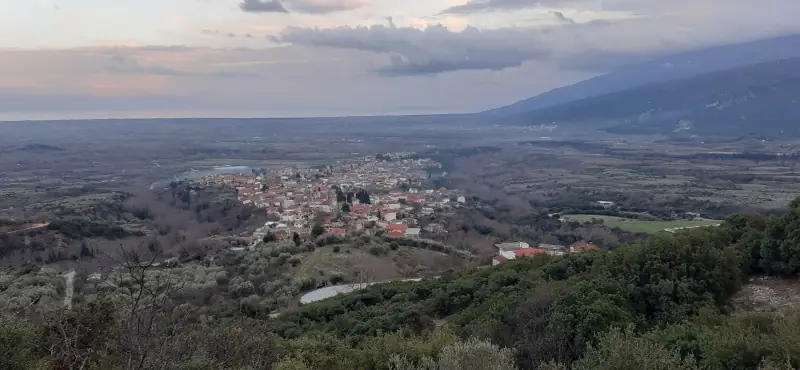
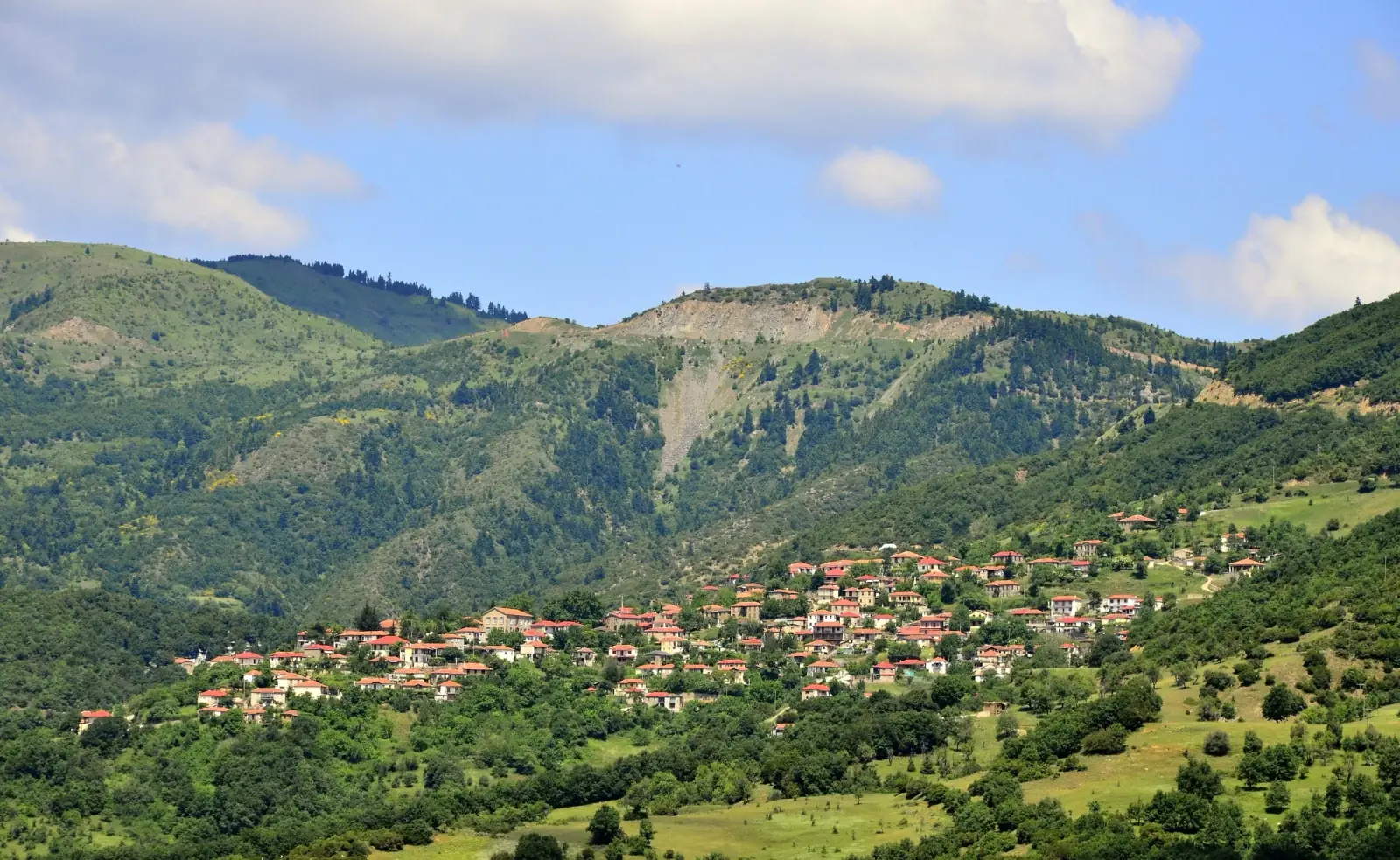
Rentina is built at around 900 metres, on the south-eastern edge of the Agrafa range, where the Karditsa regional unit meets Evrytania and Fthiotida. The 2021 census counted around 260 permanent residents. It belongs to the Municipality of Sofades and since 2012 it has been its historic seat. It is a listed traditional settlement, and among the houses stone-built mansions survive.
History explains the mansions. Under Ottoman rule the Agrafa had privileges under the Treaty of Tamasi, and Rentina became one of their largest and richest villages, with 450 families. It lived from livestock and, to a lesser degree, from silk. It had a library and a school where ancient Greek and Latin were taught, and it was the seat of the bishopric of Litza and Agrafa. People called it the «Queen of the Agrafa». Because it stood on the road from Thessaly to western Greece, it also paid the price: battles were fought here in 1821, and again in 1845, 1867 and 1878. It became part of Greece in 1881, with the rest of Thessaly. For how these mountains stayed out of the tax registers, see our article on the Agrafa.
Churches with dates
On the central square stands Agios Georgios, a 17th-century church with wall paintings from 1719 and a carved wooden iconostasis from 1796. It has two chapels. That of Agios Dimitrios was built in 1662. The other, of Agios Serafeim, has housed the Ecclesiastical Museum since 1975, with portable icons, vestments, liturgical vessels and books. The oldest book was printed in Venice in 1538. Highlights are an icon of the Virgin from 1588, a patriarchal document from 1799 and the sanctuary doors from the monastery of Rentina.
The village also has the church of the Panagia, the old cathedral of the bishopric, with a 17th-century iconostasis. Agios Nikolaos, on another square, was renovated in 1725. The village's third museum is the Folklore Museum.
Seven kilometres to the south-east is the Monastery of Rentina, dedicated to the Dormition of the Virgin. Sources date its main church to 1579 or 1640.
Getting there and what to know in November
From Karditsa the road passes Kedros and Loutra Smokovou. Rentina is about 56 kilometres from the city, according to the Municipality of Sofades, and the last stretch, after the baths, is full of bends. The same road carries on to Karpenisi.
Autumn here is tsipouro season. On 24 October the 18th Tsipouro Festival was held on the central square by the Municipal Unit of Rentina, the Women's Association and the Cultural Association of Rentina People in Karditsa, with the support of the Municipality of Sofades.
Two practical notes. We found no published opening hours for the museums this year, so phone the Municipality of Sofades before you go up, to be sure you will find them open. And at 900 metres November can bring fog, morning ice or the first snow. Check the weather and the state of the road on the day, and set off early, so that you drive the bends back down in daylight.