The history of Larissa
The history of Larissa and its region: prehistoric settlements, the Aleuadae, Saint Achillius, Ottoman Yenişehir, 1881, the Kileler uprising and the 1941 earthquake.
Larissa is the largest city in Thessaly and one of the oldest continuously inhabited cities in Greece. Built on the banks of the river Pineios, in the heart of the plain, it has been a centre of power, trade and faith for thousands of years.
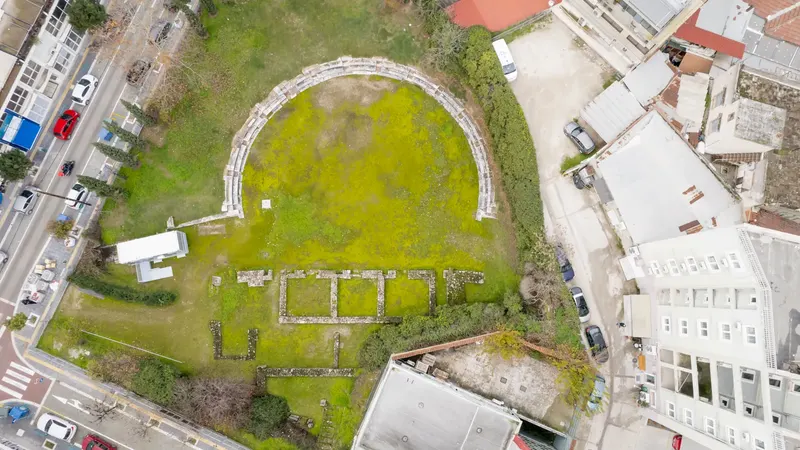
Today its ancient theatres, Byzantine basilicas, the Ottoman Bezesteni and neoclassical façades stand side by side, like the layers of a book you read on foot.
Prehistory
People on the banks of the Pineios
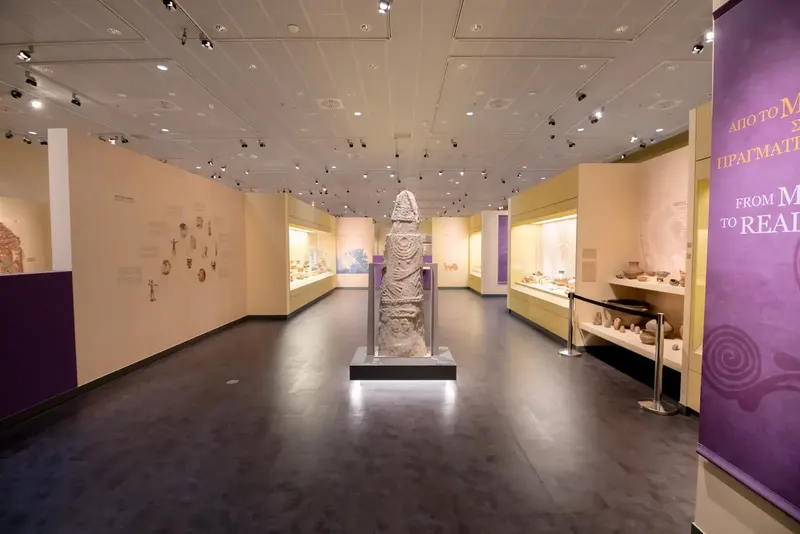
Traces of human presence have been found along the Pineios as far back as the Palaeolithic. In the Neolithic the plain filled with villages: the low mounds, the magoules, that still dot the Thessalian landscape are often the remains of those first settlements.
Antiquity
The city of the Aleuadae
Ancient Larissa was one of the most powerful cities of Thessaly. In the Archaic and Classical periods it was dominated by the aristocratic family of the Aleuadae, whose influence reached far beyond the plain.
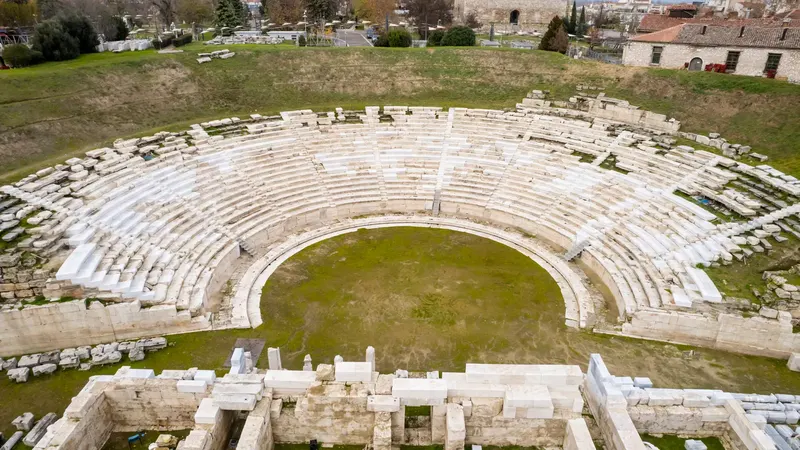
According to myth, it was at Larissa that Perseus accidentally killed his grandfather Acrisius with a discus. According to tradition, Hippocrates, the father of medicine, also died here. In the 3rd century BC the city built its great theatre on the southern slope of the Fortress hill.
Rome and Byzantium
The city of Saint Achillius
In Roman times Larissa kept its place as the centre of Thessaly. With the spread of Christianity it became an important bishopric. Its bishop, Saint Achillius, took part in the First Ecumenical Council (AD 325) and is still the city's patron saint.
On the Fortress hill stand the ruins of an Early Christian basilica, witnesses of Byzantine Larissa.
Ottoman period
Yenişehir, the New City
The Ottomans took Larissa at the end of the 14th century and named it Yenişehir, the New City. For centuries it was an important administrative and military centre, with mosques, baths and markets.
From that time survives the Bezesteni, the covered market for precious goods, which has been restored and given back to the city.
1881 to today
From union with Greece to a modern centre
In 1881 Larissa became part of the Greek state, together with most of Thessaly. During the war of 1897 it briefly returned to Ottoman control.
In March 1910 Kileler, a village in the region, became the symbol of the sharecroppers' uprising for land. On 1 March 1941 a strong earthquake destroyed much of the city, shortly before the German invasion.
After the war Larissa grew quickly into the main agricultural, commercial and medical centre of Thessaly, with university departments, museums and a lively city built around its ancient monuments.